
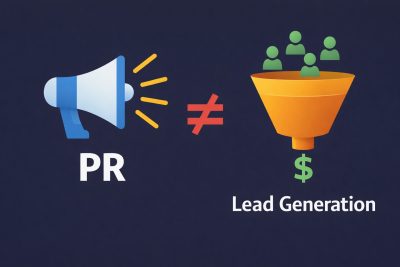
At the end of my last blog I was questioning whether PR was now actually becoming a kind of lead generation device. For most of my career, I have told clients something very clearly:
- Public relations is not a lead generation strategy, and
- You should not measure PR success by counting leads.
That guidance was accurate for its time. PR builds awareness, establishes credibility, and shapes perception. But it was never a predictable, on-demand, direct-response engine.
Having worked through my confusion I can say it still isn’t a lead generation strategy, but with Gartner reporting that 36% of CCOs anticipate PR budgets increasing as a result of AI; clearly something is changing.
It seems in 2026, artificial intelligence has forced me/us to refine that position; but not completely abandon it. Looks like PR is evolving into growth infrastructure that directly influences discoverability, credibility, and conversion.
In this post we’ll explore how AI and generative search are reshaping PR, and which PR tool categories can help your organization thrive.
Why PR Wasn’t Measured by Leads
Historically, PR lacked three critical elements for direct lead generation:
- Precise attribution
- Distribution control
- Predictable conversion pathways
We couldn’t reliably say: “This press coverage produced 47 qualified leads.”
Earned media influenced trust and consideration, often invisibly and over time. Tying PR to lead counts undervalued its true impact. But as is true across many industries, AI has changed the rules.
AI Has Merged Visibility, Credibility, and Discovery
Search is no longer just a list of links. Generative AI now synthesizes answers from trusted sources. If your organization is:
- Quoted in credible media
- Publishing defensible thought leadership
- Cited by analysts
- Referenced in authoritative research
…it is more likely to appear in AI-generated answers.
Earned media is no longer just awareness, now it is effectively “discoverability infrastructure.” PR now directly influences whether potential buyers or investors even see your brand.
Generative Engine Optimization (GEO) Makes PR Structural
AI engines rely on authoritative sources:
- Expert commentary
- Verified media coverage
- Data-backed reporting
Organizations absent from these ecosystems risk being invisible in AI-generated responses. PR feeds these systems, making it a critical component of brand visibility.
Attribution and Measurement Are Improving
Finally, modern analytics make PR more measurable:
- Branded search lift following coverage
- Share-of-voice correlation with pipeline acceleration
- CRM integration tracking first- and multi-touch exposure
While PR is still not a direct-response channel, its influence on:
- Conversion rates
- Sales cycle velocity
- Investor confidence
- Partnership discussions
…is far more tangible and measurable than ever.
PR Is Not Paid Media, but it IS a Growth Lever
PR should not be evaluated like paid ads:
- It does not generate predictable leads on demand
- Its ROI is contextual and long-term
Instead, measure PR by its ability to:
- Strengthen trust before first contact
- Improve close rates
- Shorten sales cycles
- Ensure inclusion in AI-generated answers
- Protect reputation and credibility
The New Role of PR in the AI Era
PR is now:
- Visibility infrastructure – feeds AI answer engines
- Credibility amplifier – builds trust and authority
- Conversion accelerator – increases likelihood of lead conversion
- Defense system – mitigates misinformation, deepfakes, and reputational risk
This evolution effectively elevates PR from a support function to a strategic growth lever. Organizations that invest in PR literacy and AI-savvy communications can gain a measurable competitive advantage.
Recommended PR Tool Categories for 2026
If you’re evaluating PR in 2026, the tool categories that matter most include:
- PR Measurement Tools – Connect earned media to revenue impact*
- Media Monitoring Platforms – Protect credibility and respond to misinformation
- Media Contact Databases – Ensure visibility and outreach for GEO
- Press Release Distribution Services – Make assets citation-friendly and SEO-ready
- AI PR Tools – Support AI-assisted research, content drafting, and evaluation
* PR agencies are increasingly expected to demonstrate revenue impact, but they rarely control the systems where revenue data lives. This PR attribution gap will be the focus of an upcoming post that explores the tools that can help your organization translate PR activity into measurable business outcomes while remaining credible and trustworthy.
Conclusion
For years, I told clients:
“PR is not a lead generation device.”
Today, the statement needs refinement:
PR is not a direct-response tactic — but in the age of AI, it is growth infrastructure.
It shapes whether your organization:
- Appears in AI-generated answers
- Earns third-party validation
- Converts skeptical buyers
- Maintains narrative control
- Withstands misinformation
That is not just awareness — it is measurable influence. PR increases the probability that leads will convert. And in a world where trust is scarce, AI is pervasive, and credibility determines inclusion, that probability lift may be one of the most powerful growth-levers your organization has.
I didn’t see that coming. Did you?