
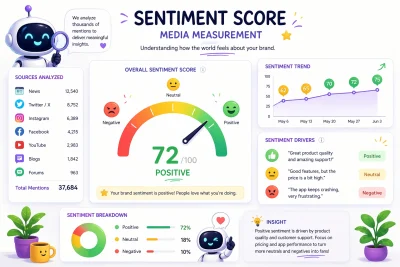
Measurement has always been the uncomfortable conversation in PR. For decades the industry has wrestled with how to demonstrate value in terms that go beyond clip counts and advertising value equivalents. Progress has been made. Attribution modelling has improved. The connection between earned media and pipeline outcomes is better understood than it was ten years ago.
But just as that conversation was starting to mature, the environment shifted again. Knowing how to measure PR success with AI search is now a genuine requirement for communications teams that want to report accurately on what their work is actually achieving. The gap between what is being measured and what is actually driving discoverability is widening, and the teams that close that gap first will be significantly better positioned both strategically and commercially.
Why Current PR Measurement Frameworks Are Incomplete
When a potential buyer, investor, or journalist asks an AI platform a question relevant to a client’s space, one of three things happens. The client is cited as an authoritative source. A competitor appears instead. Or the AI generates an answer that includes neither, drawing on generic sources that leave the client entirely out of the conversation.
Most PR reports have no way of capturing which of those outcomes is happening, how frequently, or why. Coverage is tracked. Sentiment is tracked. Share of voice in traditional media is tracked. But share of voice in AI-generated answers, which is increasingly where audiences form first impressions, is largely absent from standard reporting.
This is not a criticism of how PR measurement has been done. It is a recognition that the environment has changed faster than the frameworks used to evaluate it. The Gartner finding that 36 percent of CCOs anticipate PR budgets increasing as a result of AI reflects a recognition at senior level that communications has a more significant role to play in this environment. The practitioners who can translate that recognition into a clear and credible measurement framework are the ones best positioned to benefit from that shift.
What AI Citation Tracking Actually Involves
Tracking AI visibility does not require a sophisticated technical setup to begin with. The starting point is systematic manual monitoring across the AI platforms most relevant to a client’s audience.
That means regularly searching for the queries a target audience is most likely to ask, across ChatGPT, Perplexity, Google AI Overviews, and Microsoft Copilot, and recording where the client appears, how they are described, and which competitors are showing up alongside or instead of them. Done consistently over time, this builds a picture of AI share of voice that is genuinely useful for both strategy and reporting.
The next level is understanding what content activity correlates with changes in that visibility. When a client publishes a piece of thought leadership in an authoritative outlet, does their AI citation frequency improve over the following weeks? When positioning language shifts, does the way AI systems describe the client change accordingly? These connections between PR activity and AI visibility outcomes are what make the measurement meaningful rather than just descriptive.
Extending the PR Report Without Rebuilding It
The structure of a PR report does not need to be rebuilt from scratch to accommodate AI visibility metrics. It needs to be extended. The standard components of coverage volume, key placements, reach estimates, sentiment analysis, and share of voice remain relevant and should stay. What changes is the addition of an AI visibility layer that captures what is happening in generated search alongside traditional media.
A report that includes where a client appears in AI-generated answers for their most important queries, how that compares to the previous period, which competitors are being cited more frequently, and what content activity appears to be driving movement tells a more complete story than one that covers traditional media alone. It also signals to clients that their communications partner understands how discoverability has changed and is actively managing it rather than simply monitoring traditional outputs.
Some clients will immediately understand the significance of this framing. Others will need it explained. The most effective explanation tends to be competitive. Asking a client to search for a question their target buyer would ask in ChatGPT and see who appears tends to make the point more clearly than any amount of abstract explanation about AI search trends.
Addressing the Attribution Gap Honestly
One of the persistent challenges in PR measurement is attribution. Demonstrating that a specific piece of coverage contributed to a specific business outcome has always required inference because PR operates through trust and perception rather than direct response. AI visibility adds a new dimension to this challenge rather than solving it.
When a buyer encounters a client in an AI-generated answer, follows up with a search, lands on the website, and eventually converts, the AI citation is part of that journey but is unlikely to appear in any analytics platform as a discrete traffic source. The influence is real. The direct attribution is not straightforward.
The appropriate response is not to abandon measurement but to build a framework that captures what can be captured and is honest about what cannot. Combining AI citation tracking with branded search monitoring, direct traffic analysis, and CRM data on how prospects describe their first encounter with a client gives a more complete picture than any single metric alone. It is imperfect. It is also significantly more accurate than ignoring AI visibility entirely and reporting only on traditional media metrics.
The Metrics That Matter Most
Building a practical AI-era PR measurement framework means identifying which metrics to track, how frequently, and what to do with the data.
AI share of voice is the most directly relevant new metric. How often does the client appear in AI-generated answers for the queries that matter most to their audience, and how does that compare to named competitors? This is measurable, trackable over time, and directly relevant to strategic decision-making.
Branded search lift following coverage remains a valuable indicator of PR impact that bridges traditional and AI-era measurement. When a piece of coverage lands, an increase in branded search volume suggests it has reached an audience that then went looking for more information, a pattern that often correlates with AI citation activity as well.
Source authority of coverage is worth tracking more explicitly than it has been in traditional reporting. Not just which outlets covered the client but what domain authority those outlets carry and therefore how much weight that coverage is likely to generate as an AI credibility signal.
Positioning consistency across coverage is a qualitative metric that is worth including in reporting. Are the core descriptors and positioning points appearing consistently across placements? Is the client being described in a way that builds a coherent picture across sources? This connects directly to AI visibility outcomes and gives clients a clear view of whether the messaging architecture is holding.
Conclusion
Knowing how to measure PR success with AI search is not about replacing existing frameworks. It is about making them accurate. The work of building credibility, earning authoritative coverage, and developing consistent expert positioning has always been what PR does best. What has changed is that those outputs now need to be measured against a broader set of channels, including the AI systems that are increasingly shaping how audiences discover and evaluate brands.
The teams that build this capability now, while the measurement category is still developing and the competitive advantage of doing it well is still meaningful, will define what modern PR reporting looks like for the years ahead.
FAQ
How do I start measuring PR success with AI search if I have no baseline? Begin with manual monitoring. Search for the five to ten queries most relevant to each client across ChatGPT, Perplexity, and Google AI Overviews. Record the results and repeat on a consistent schedule. Even a three-month baseline gives you meaningful data to work with and report on.
What AI citation monitoring tools are available for PR teams? The category is developing quickly. The Monitoring and Measurement section on PRToolFinder covers current platforms with practical context, which is a useful starting point for teams assessing what is available without committing to contracts before understanding the options.
How do I explain AI citation metrics to a client who is not familiar with them? The competitive framing tends to work best. Ask the client to search for a question their target buyer would ask in ChatGPT and see who appears. If a competitor appears and they do not, the conversation follows naturally. If they appear strongly, that is a reportable win worth building on.
Should AI visibility metrics replace traditional PR metrics? No. They should sit alongside them. Traditional metrics still capture important dimensions of PR value and the publications generating traditional coverage are largely the same ones that AI systems treat as authoritative. AI visibility metrics add a layer that reflects how discoverability has changed, giving a more complete and accurate picture.
How does AI citation performance connect to demonstrating PR ROI? It adds a measurable dimension to discoverability that sits between earned media activity and downstream business outcomes. Combined with branded search data and CRM attribution, it builds a more complete picture of how PR contributes to business results than traditional media metrics alone can provide.