There is a moment that is becoming increasingly common in PR conversations. A client asks why a competitor keeps appearing in AI-generated summaries of their industry. The PR team has no immediate answer because nobody briefed them that this was now part of the job. They were doing solid traditional work. They just had not connected it to how AI systems decide whose voice is worth including.
Earning AI citations for PR clients is not a separate specialty. It is an extension of what good communications work has always been. The difference is in understanding what AI systems are looking for and building a strategy that feeds those signals deliberately.
What an AI Citation Actually Is and Why It Matters
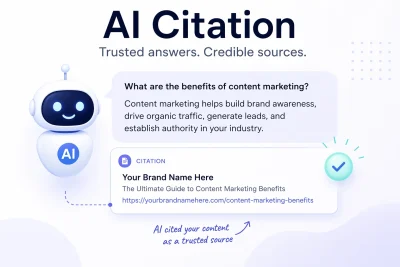
When someone asks an AI platform a question and receives a generated answer, the sources that answer draws from are effectively being cited as authoritative. In some platforms those citations are visible. In others the influence is less transparent but no less real. Either way, the brand or expert being referenced is being positioned as credible and relevant by a system that millions of people now treat as a primary research tool.
The value of that positioning is significant. It is not equivalent to a paid placement or a sponsored post. It carries the implicit endorsement of a system the user has chosen to trust. For PR professionals who have spent careers building exactly that kind of third-party credibility, the mechanism is familiar even if the channel is new.
The question is how to earn it consistently and how to know when it is working.
The Signals AI Systems Use to Decide Who Gets Cited
AI systems do not make citation decisions randomly. They are trained to weight sources that demonstrate consistent signals of authority and credibility. Understanding those signals is the first step to building a strategy around them.
Source authority is the most fundamental factor. Publications and platforms with strong editorial standards, high domain authority, and a track record of credible content generate stronger signals than lower-authority outlets. A placement in a well-regarded industry publication carries more weight in an AI citation context than a high volume of coverage in lower-authority sites.
Consistency of positioning is equally important. When a brand or individual expert is described in similar terms across multiple independent sources, AI systems build a coherent picture of what that entity does and why it is relevant. Inconsistent messaging across coverage fragments that picture and weakens the signal considerably.
Corroboration matters too. When the same claim about a client appears across multiple credible independent sources, it is treated as more reliable than a claim that appears in only one place. This is why building a broader ecosystem of coverage and owned content around a single positioning point is more effective than a scattergun approach to topics and messages.
Named expert attribution also plays a role. AI systems weight content more heavily when it is clearly attributed to a named individual with verifiable credentials. Anonymous or loosely attributed content carries less authority. Building a client’s leadership team as recognized experts with consistent public profiles across authoritative sources is one of the most durable AI citation strategies available.
Building a Content Ecosystem That Earns Citations
Earning AI citations consistently requires thinking about content as an ecosystem rather than a collection of individual placements. Each piece of coverage, owned content, or expert commentary should reinforce the same core positioning and contribute to a pattern that AI systems can recognize.
The starting point is always message consistency. Define the two or three things a client is unambiguously known for and make sure those descriptors appear consistently across every piece of content in the ecosystem. Press releases, bylines, media commentary, LinkedIn articles, podcast appearances. The language does not need to be identical but the positioning should be unmistakable.
Thought leadership needs to be treated as a core workstream rather than an occasional add-on. A client whose leadership team publishes consistently in credible outlets, contributes expert commentary on well-regarded platforms, and builds a body of work that AI systems can draw from is in a fundamentally stronger position than one whose public presence is sporadic. Consistency of output over time builds authority in a way that periodic bursts of activity cannot replicate.
Owned content plays a supporting role that is often underestimated. A well-structured owned content program that reinforces earned media positioning, answers the questions a target audience is asking, and is published consistently on a site with reasonable domain authority contributes meaningfully to the overall signal. It is not a substitute for earned media but it is an important part of the ecosystem.
The Tools That Support an AI Citation Strategy
Building and maintaining an AI citation strategy requires tools that go beyond traditional media monitoring. The PR technology landscape has developed significantly in this area and the difference between teams using the right platforms and those relying on outdated approaches is widening.
AI citation monitoring platforms track how clients appear in generated answers across the major AI platforms. Some provide competitive benchmarking, showing how a client’s AI visibility compares to named competitors. Others focus on identifying the content and sources driving citation frequency, which is directly useful for strategy.
Media monitoring platforms with AI visibility features are also becoming more relevant. Understanding not just where coverage appears but how that coverage is being processed and weighted by AI systems gives a more complete picture than traditional clip reporting.
For PR professionals evaluating what belongs in their technology stack, the AI and Writing Tools and Monitoring and Measurement categories on PRToolFinder cover the current landscape with practical context. The database is built specifically to help communications professionals make informed tool decisions without relying on vendor marketing, which is particularly useful in a category developing as quickly as AI visibility.
How to Report on AI Citation Performance
Measuring and reporting on AI citation performance requires extending current frameworks rather than replacing them. The core metrics of coverage volume, publication authority, share of voice, and sentiment remain relevant. What changes is the addition of an AI visibility layer that captures what is happening in generated search.
The simplest version of this is regular manual monitoring. Search for the queries most relevant to a client across ChatGPT, Perplexity, and Google AI Overviews. Do this on a consistent schedule and record where the client appears, how they are described, and which competitors show up alongside or instead of them. Done consistently, this builds a baseline and tracks movement over time.
As dedicated tooling matures, this process becomes more structured and scalable. But even at the manual stage, including an AI citation section in client reports sends a clear signal that the PR team understands how discoverability has changed and is actively managing it. That alone differentiates a communications partner from one still reporting exclusively on traditional media metrics.
Conclusion
Earning AI citations for PR clients is not a radical departure from what good communications work has always involved. It is the same discipline applied with a clearer understanding of a new and increasingly important audience. The AI systems generating answers that millions of people rely on are making credibility judgements based on exactly the signals PR has always been in the business of building.
The practitioners who understand this and build it into how they work, what they measure, and which tools they use will find themselves with a genuine and durable advantage. The work is not new. The deliberateness with which it needs to be applied is.
FAQ
What is an AI citation in PR terms? An AI citation is when a brand, expert, or piece of content is referenced as a source in an AI-generated answer. It represents a form of third-party credibility endorsement that carries significant weight with audiences who use AI platforms as a primary research tool.
How long does it take to start earning AI citations? There is no fixed timeline. Clients with consistent positioning and existing coverage in authoritative outlets tend to see improvements faster than those starting from a low baseline. A focused six to twelve month program of consistent messaging and authority building typically produces measurable movement.
Is earning AI citations different for B2B versus B2C clients? The fundamentals are the same but the relevant sources and platforms differ. B2B clients benefit most from citations in industry-specific authoritative publications and from expert profiles in trade and professional contexts. B2C clients benefit from broader consumer-facing coverage. In both cases consistency and authority are the core levers.
What is the difference between SEO and earning AI citations? Traditional SEO focuses on ranking web pages in search results. Earning AI citations focuses on being included in generated answers. The two are related because AI systems draw on well-indexed, authoritative content but the strategic emphasis is different. SEO asks how does this page rank. AI citation strategy asks how does this content contribute to a pattern of credibility that an AI system will recognise and cite.
Where can I find tools to help build and track an AI citation strategy? The AI and Writing Tools and Monitoring and Measurement sections on PRToolFinder are a practical starting point for understanding what platforms are available and how they compare without wading through vendor sales pages.