
Week 2: AI Generative Tools (TEXT)
This week’s Tool School has been fun to work on since I love research and writing.
PR has always been about words.
The pitch. The press release.
The statement.
The strategy behind all of it.
But here’s what’s changed:
We’re now expected to produce more content, faster, across more channels — without sacrificing quality, originality, or strategic thinking.
That’s a pretty big ask.
So, what happens in the real world?
- You rewrite the same content five different ways
- You spend hours structuring drafts before you can even refine them
- Or you rush something out that’s… good enough
That’s exactly where AI writing tools are changing the game.
I’ll admit, I do worry a little about AI making the next generation lazy (or my own, for that matter). But what I’ve come to realize is that collaborating with AI is often less about replacing thinking and more about unlocking it.
I have a friend and colleague who’s brilliant in sales and strategy. He once confessed that he had dozens of half-finished article ideas sitting in folders because he just couldn’t seem to get them across the finish line. He knew what he wanted to say, he just got stuck somewhere between the idea and the execution.
And honestly? I think a lot of us can relate to that.
That’s where these tools can be genuinely exciting.
Because while words matter, imagination, insight, originality, and vision matter even more. If an AI collaborator helps coax out an idea you couldn’t quite articulate before — or helps you finally finish something worth saying — that feels like a pretty meaningful use of technology to me.
So, we’re not here to judge it.
AI isn’t going anywhere, which means our best move is to learn how to use it thoughtfully, strategically, and responsibly. That’s really the theme of this week.
Last week, we explored how design tools are helping PR pros create polished visuals without a graphic design degree. This week, we’re looking at the AI writing and content tools helping us create the messaging those visuals are supporting.
What This Category Actually Solves for PR Teams
The conversation around AI usually starts with “writing faster,” but for PR teams, it’s actually much bigger than that.
These tools help solve three very real workflow problems:
- Getting the First Draft Started
Sometimes the hardest part isn’t writing — it’s starting. No longer do you have to stare at your screen until beads of blood form on your forehead. But don’t let AI do your first draft for you – get your thoughts (messy as they may be) on the page first. This is really important because YOU are the one that is the original – AI is not.
However, AI tools can help PR pros quickly structure:
- Press releases
- Media pitches
- Executive messaging
- Social content
- Thought leadership drafts
That means less time staring at a blank page and more time refining ideas.
- Turning One Idea into Multiple Assets
PR work rarely stops at one deliverable anymore.
One announcement might need:
- A press release
- A LinkedIn post
- An email pitch
- Executive talking points
- A blog summary
- Social captions
AI tools are especially good at helping teams repurpose and adapt content without rewriting everything from scratch.
- Creating More Space for Strategic Work
This may be the biggest shift of all.
The more time we save on repetitive drafting, formatting, restructuring, and rewriting, the more time we have for the work that actually requires human judgment:
- Media relationships
- Positioning
- Messaging strategy
- Reputation management
- Creative thinking
And that’s where PR professionals bring the most value.
What to Look for in AI Writing Tools
Not all AI writing tools are built for the same kind of work.
Some are general-purpose collaborators.
Some are designed specifically for marketers.
And a few are now being built specifically for communications professionals.
A few things that matter most for PR teams:
- Strong output quality and tone control
- Easy iteration and rewriting
- Support for PR-style formats and structure
- The ability to adapt messaging across channels
- Ease of use (without needing a PhD in prompt engineering)
Because let’s be honest — most PR pros don’t have time to become AI engineers too.
3 Types of AI Writing Tools PR Pros Should Know
General AI Writing Platforms
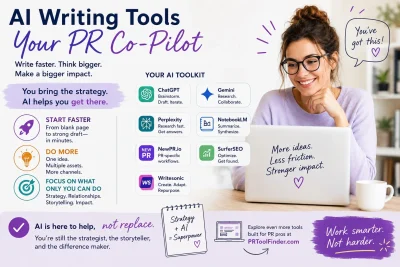
Examples: ChatGPT, Gemini, Claude
These are the tools most people started experimenting with first — and for good reason.
What they’re great at:
- Brainstorming
- Draft generation
- Rewriting and repurposing
- Research support
- Thought partnership
A lot of PR pros have also started developing preferences depending on the task:
- Claude is often favored for long-form writing and nuanced tone
- ChatGPT is widely used for ideation, structure, and fast iteration
- Gemini tends to fit naturally into Google-based workflows and research tasks
The challenge:
They’re incredibly flexible, but they still rely heavily on you to guide the structure, tone, and strategy behind the output.
Which means your PR instincts still matter. A lot.
PR-Specific AI Platforms
This is where the category starts getting really interesting.
One of the newest entrants is NewPR.io, a platform designed specifically around PR and communications workflows.
Instead of expecting users to invent prompts from scratch, tools like this are starting to build PR frameworks directly into the experience.
What it helps with:
- Press releases
- Media pitches
- Crisis communications
- Speechwriting
- Messaging strategy
- Social media planning
What makes it different:
The structure already understands the communications context.
That means:
- Press releases follow recognizable formats
- Outputs feel more aligned with professional standards
- Workflows mirror how PR teams actually work
And honestly, that’s important.
Because one of the biggest barriers to AI adoption in communications isn’t fear — it’s friction. A lot of people simply don’t know how to ask for what they need yet.
PR-specific platforms help lower that barrier considerably.
⚙️ AI-Enhanced Writing & SEO Tools
Examples: Writesonic and SurferSEO
These tools sit somewhere between AI generation and optimization.
What they’re especially useful for:
- SEO-informed blog content
- Improving readability
- Optimizing headlines and structure
- Refining messaging for discoverability
- Adapting content for digital channels
This is becoming increasingly important because PR and content marketing continue to overlap.
It’s no longer enough to create good content. Increasingly, teams also need content that:
- Gets discovered
- Performs in search
- Supports authority-building
- Extends campaign visibility over time
That’s where these tools can really help.
When to Use What
- Use general AI tools when you need flexibility, brainstorming, or collaboration
- Use PR-specific tools when speed and communications structure matter most
- Use SEO and optimization tools when visibility and performance matter
The smartest workflows usually combine all three. We’ll be publishing a handy guide later this week as part of our new Tool School format and we’ll let you know when it’s up!
The Bigger Shift Isn’t About Writing Faster
It’s about removing friction.
The PR professionals who get the most value from AI aren’t using it to avoid thinking.
They’re using it to:
- Explore ideas faster
- Reduce repetitive work
- Scale strong messaging
- Create more consistently
- Spend more time on strategy and relationships
That’s the real opportunity here.
Tool School Takeaway
The advantage isn’t just access to AI.
It’s learning:
- Which tool fits which task
- How to collaborate with AI effectively
- Where human judgment still matters most
Because PR has never just been about producing content.
It’s about communicating ideas in ways that move people.
And no matter how smart these tools get, that part still belongs to us.
Work Smarter, Not Harder
PRToolFinder organizes AI writing tools by real-world use case so you can quickly explore what fits your workflow best.
Watch our new video and then Explore the AI Generative Text category