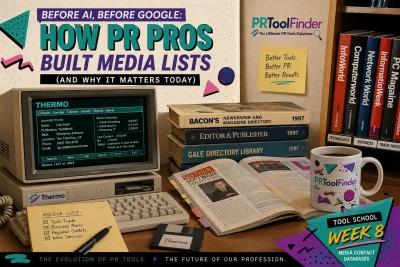
Tool School Preview: Week 8 – Media Contact Databases
If you’ve only worked in PR over the last ten or fifteen years, it’s hard to imagine a world without searchable media databases.
Need to find a healthcare reporter in Sacramento?
Open a database.
Apply a few filters.
Export your list.
Done.
But for those of us who built media lists before the internet transformed public relations, the process looked very different.
As we prepare for Tool School Week 8, I thought it would be fun to take a quick trip back through the evolution of media contact databases—and what it was really like to build a media list before AI, before cloud software, and even before Google.
A Day in the Life of a PR Professional in the 1990s
Imagine it’s 1997.
A client has just announced a new software product, and your account executive walks over with a simple assignment:
“Build me a media list.”
Today, that might take fifteen minutes.
Back then, it could easily consume half a day—or more.
You started by pulling thick media directories from the bookshelf. Bacon’s directories, Editor & Publisher, Gale’s directories, and stacks of regional media guides were staples in nearly every agency.
Then came the research.
Who actually covered your client’s industry?
Had the reporter recently changed beats?
Did they prefer email, fax, or phone?
Were they a columnist? A staff writer? A contributing editor?
Much of that detective work meant reading the publications themselves.
Many agencies—including one where I worked—maintained physical libraries filled with trade magazines and newspapers. Account executives regularly pulled issues from the shelves to study how reporters covered an industry before making a pitch.
Building a thoughtful media list wasn’t simply data entry.
It was research.
My First Look at the Future
One of the things I remember most while working at UpStart Communications (besides the awesome people), was an innovative custom software build they developed that internally we lovingly called “Thermo”.
Long before today’s cloud-based PR platforms existed, UpStart had built something remarkably innovative. It was the agency’s proprietary software—its “secret sauce.”
Looking back nearly thirty years later, Thermo feels like an early version of today’s integrated PR suites.
It tracked thousands of technology journalists, stored detailed contact information, logged interactions between reporters and agency staff, documented what each journalist had covered, and even included editorial calendars that staff members maintained manually for the technology publications we pitched throughout the year.
By today’s standards, it was clunky. It wasn’t especially fast. But it was transformational.
Even more impressive, if I’m remembering correctly, it supported remote access—a capability that was surprisingly advanced for the late 1990s. That meant account teams could access information without being physically in the office, dramatically improving collaboration and productivity.
It showed me something I’ve never forgotten:
The firms that organize knowledge better than everyone else gain an enormous competitive advantage.
From Printed Directories to Intelligent Discovery
Media databases have evolved through several distinct generations.
Generation One: The Printed Directory
For decades, printed directories like Bacon’s and Editor & Publisher were the industry’s gold standard.
Their job was straightforward:
“Tell me who covers healthcare in Chicago.”
Finding the answer required patience—and plenty of page-turning.
Generation Two: Searchable Online Databases
As the internet matured, those printed directories became searchable online platforms.
Companies including Cision, Muck Rack, Agility PR Solutions, Prowly, and Propel transformed media research.
PR professionals could now filter journalists by:
- Beat
- Location
- Media outlet
- Circulation
- Publication type
- Topics covered
What once required hours could now be completed in minutes.
Yet one thing hadn’t changed.
The best PR professionals still researched the reporter before reaching out. Reading recent articles, understanding a journalist’s interests, and tailoring a pitch remained largely a manual process.
Generation Three: Intelligence Platforms
Today we’re entering another era.
Media databases are becoming intelligence platforms powered by artificial intelligence.
Instead of asking:
“Find healthcare reporters in California.”
We’re beginning to ask:
“Which reporters have written extensively about rural hospital closures, regularly quote nonprofit leaders, and recently covered Medicaid funding?”
That’s no longer just a database search.
It’s contextual discovery.
It’s relationship intelligence.
And it’s changing how PR professionals identify the right journalist—not simply the available journalist.
Looking Ahead
Media contact databases have come a long way from shelves lined with printed directories and agency libraries filled with magazines.
But despite all the technological change, one thing hasn’t changed at all.
Successful media relations has never been about collecting the biggest list.
It’s always been about finding the right journalist with the right story at the right moment.
Next week in Tool School, we’ll take a deep dive into today’s leading media contact databases, explore how AI is reshaping this category, compare the major platforms, and answer a question that’s becoming increasingly important:
Will AI replace media contact databases—or make them more valuable than ever?