Welcome back! If you missed part 1 of this fun filled journey into the history of marketing you can read it here.
The Dawn of Computing—the 1950s
The 1950s saw the systematization of telemarketing, and while this marketing tool still persists, it is much despised. On the other hand, a lot of great things happened in the ’50s.
Science took a big leap forward with the invention of the semiconductor—which would lead to the development of the integrated circuit and make modern computing possible. Founded in 1957 by the “Traitorous Eight” who defected from Shockley Semiconductor, Fairchild Semiconductor is the legendary company that led the field and helped build Silicon Valley. They invented the commercial planar integrated circuit (the microchip) and spawned legendary tech spin-offs like Intel and AMD. Today, Fairchild operates as a division of onsemi, a global supplier of power semiconductors.
Who Were the Traitorous Eight?
If you’ve spent even a little time in the tech world, you’ve probably heard of Moore’s Law. But before Gordon Moore became one of the giants of Silicon Valley, he was part of a group of eight scientists and engineers who made a rather consequential break with their employer.
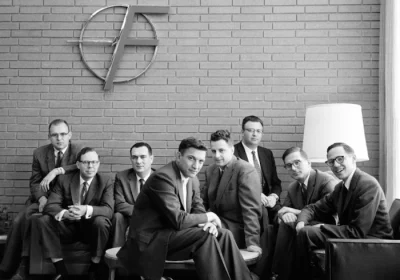
In 1957, Julius Blank, Victor Grinich, Jean Hoerni, Eugene Kleiner, Jay Last, Gordon Moore, Robert Noyce and Sheldon Roberts left Shockley Semiconductor Laboratory. They went on to establish Fairchild Semiconductor, a company that would become enormously influential in the development of the modern semiconductor industry.
The eight became known as the “Traitorous Eight,” a name reportedly bestowed by Shockley himself after they left his company.
Among them was Gordon Moore, who would later co-found Intel with Robert Noyce. Moore is best known for what became known as Moore’s Law—the observation that the number of transistors that can be packed onto an integrated circuit tends to increase dramatically over time, roughly doubling every couple of years. That observation became a shorthand for the extraordinary pace of technological advancement in the semiconductor industry.
I’m reading a very interesting book and am just at the point where it covers this era—it’s called Palo Alto by Malcolm Harris, “A History of California, Capitalism and the World.” (Caution: while the book is interesting, especially if you work in tech and live in the SF Bay Area, it IS 3” thick!)
During this period, marketing leaped ahead as marketers began using demographics and socioeconomic data for market segmentation, dividing consumers into smaller groups of prospects who, based on their behavior and economic status, might be more likely to buy their products.
The distinction between B2B and B2C marketing emerged as well. In fact, one of the first B2B ads ran in 1958—an iconic McGraw Hill piece that became known as “The Man in the Chair.”
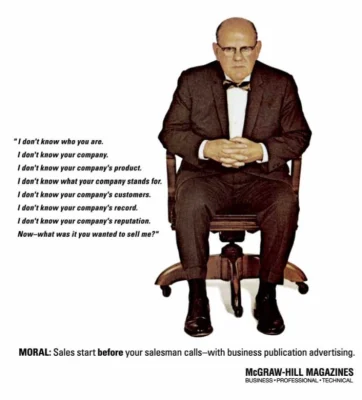
Wow. Today—where marketing automation has captured so much attention—it’s interesting to note that the idea of influencing a prospect before a sales call isn’t quite as new as we might have thought.
The fundamental idea behind market segmentation remains: instead of treating “the consumer” as one giant mass, divide the market into smaller groups that share characteristics and are likely to respond differently to a product or message. That is still standard marketing practice today.
What Changed?
In the 1950s, the breakthrough was essentially:
“Who is most likely to buy this?”
Marketers could use information such as:
- Age
- Gender
- Income
- Education
- Occupation
- Family size
- Location
- Social class
to identify concentrations of likely customers. Census and other population data made this increasingly practical.
The 1950s marketer might have said:
“We want to reach middle-income suburban women with children.”
The modern marketer can say:
“We want to reach people who fit this demographic profile, have shown these behaviors, have these interests, visited these pages, bought these products, and are currently displaying signals that suggest they might be ready to buy.”
The technology has changed dramatically. The fundamental concept of marketing segmentation hasn’t.
Innovation Acceleration—the 1960s (a sneak preview)
Consider this. More achievements in marketing occurred during the ’60s than any other decade—until the 1980s.
During the ’60s, marketing education centered on the 4 “Ps”—price, product, promotion, and place. This concept was first introduced in 1960 by E. Jerome McCarthy, who proposed the taxonomy that has since been used by marketers worldwide.
It is also in the 1960s that women begin to flex their marketing muscles!
See you next Friday with another installment! In the meantime, have a fabulous Friday and a fun-filled weekend ahead!