

Last week we explored how PR pros are using easy design tools to create polished visuals without needing a graphic design degree.
This week, we shifted to the other side of the content equation: the writing itself.
Because if there’s one thing most communications teams are dealing with right now, it’s volume.
More content.
>More channels.
>More pressure to move quickly.
And somehow… still sound thoughtful, strategic, and human.
That’s where AI writing tools can genuinely help — not as replacements for PR professionals, but as collaborators that help us think, structure, refine, research, and scale our ideas faster.
And honestly, that distinction matters.
The best PR pros aren’t handing strategy over to AI. They’re using these tools to remove friction so they can spend more time on the work humans are actually best at: judgment, creativity, relationships, positioning, and storytelling.
So if you’ve been wondering:
“What should I use for what?”
Here’s a practical breakdown.
Your Core AI Writing Tools (And Where They Fit)
ChatGPT
Still one of the most flexible AI collaborators available.
Best for:
- Brainstorming ideas
- Structuring content
- Drafting social posts
- Repurposing existing content
- Rewriting messaging quickly
Why PR pros use it:
It’s fast, conversational, and extremely versatile.
Where it shines:
When you need momentum more than perfection.
Perplexity
Think of this as research support with citations.
Best for:
- Fast background research
- Industry summaries
- Pulling together source material
- Exploring trends and competitive context
Why PR pros use it:
It helps speed up the research phase before writing even begins.
Where it shines:
When you need to get smart on a topic quickly without opening 37 browser tabs.
NotebookLM
A surprisingly useful tool for organizing and synthesizing information.
Best for:
- Summarizing uploaded documents
- Working from internal reports or transcripts
- Extracting themes from large amounts of content
- Building thought leadership from source material
Why PR pros use it:
It helps turn scattered information into usable insights.
Where it shines:
When you’re sitting on too much information and need clarity.
Gemini
Especially useful for teams already working heavily inside Google Workspace.
Best for:
- Research-heavy drafting
- Collaborative workflows
- Google Docs integration
- Quick summarization and ideation
Why PR pros use it:
It fits naturally into existing workflows.
Where it shines:
When speed and convenience inside the Google ecosystem matter.
The Specialized PR & Content Tools
🎯 NewPR.io
One of the more interesting new entries in this category because it’s being built specifically for communications professionals.
Best for:
- Press releases
- Media pitches
- Crisis communications
- Messaging frameworks
- PR workflow support
Why it stands out:
Instead of requiring elaborate prompts, it’s designed around how PR teams already work.
Where it shines:
When structure, formatting, and communications context matter.
Why this matters:
Most PR pros don’t want to become prompt engineers. They just want tools that understand the job they’re trying to get done.
📈 SurferSEO
This is where PR and discoverability start overlapping.
Best for:
- SEO-informed blog content
- Improving visibility in search
- Structuring long-form content
- Optimizing headlines and readability
Why PR pros use it:
Because content increasingly needs to perform, not just exist.
Where it shines:
Thought leadership, blog strategy, and evergreen content.
⚡ Writesonic
Built for fast content generation and marketing workflows.
Best for:
- Drafting blogs
- Social copy
- Ad copy
- Website messaging
- Content variations
Why PR pros use it:
It’s especially helpful for scaling content production quickly.
Where it shines:
When speed and iteration matter most.
So… What Should You Use When?
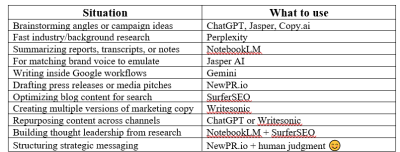
Most PR pros aren’t relying on just one AI tool — and honestly, they probably shouldn’t. It’s important to align your methodology: refine the tone you want, state constraints explicitly for the AI.
A pretty realistic workflow today might look like this:
- Use Perplexity to research a topic quickly
- Organize notes and transcripts in NotebookLM
- Draft ideas or messaging in ChatGPT
- Build a press release structure in NewPR.io
- Optimize the final blog version with SurferSEO
- Use Writesonic to adapt it into social and web copy
That sounds like a lot written out, but in practice it’s often faster than trying to do every single step manually from scratch.
And importantly: the PR professional is still driving the strategy the entire time.
A Quick Reality Check
You do not need to master every AI platform that launches next week.
Honestly, nobody can.
The smarter approach is figuring out:
- Which tools solve your biggest workflow problems
- Which ones fit naturally into how you already work
- And which ones help you spend less time producing and more time thinking strategically
That’s the sweet spot.
Tool School Takeaway
The PR professionals getting the most value from AI right now aren’t using it to replace their expertise.
They’re using it to:
- Reduce repetitive work
- Explore ideas faster
- Scale stronger messaging
- Increase consistency
- Free up more time for strategic thinking and relationships
The real advantage isn’t access to AI anymore.
It’s knowing:
👉 Which tool fits which task
👉 How to collaborate with it effectively
👉 And where human judgment matters most
Want to Explore More AI Writing Tools?
The tools in this post are just a starting point.
PRToolFinder’s AI Generative Text category organizes tools so you can quickly explore:
- PR-focused AI platforms
- SEO and content optimization tools
- Research assistants
- Content repurposing tools
- Writing collaborators
- Messaging and workflow tools
Because the goal isn’t to use every AI tool.
It’s to find the right combination that helps you work smarter. Easily upgrade to see pricing and key features and gain access to the forum.
👉 Watch our new video and then Explore the AI Generative Text category