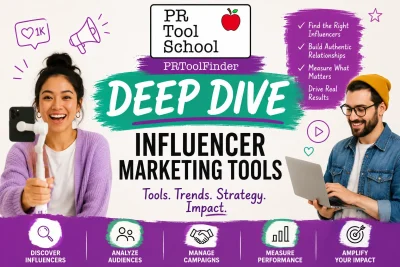
Tool School Week 6: Influencer Marketing Tools
We’ve been doing a bit of reminiscing lately – old time clipping services last week; and now we’re recalling a time when public relations visibility relied almost entirely on traditional media.
- We pitched journalists.
- We landed interviews.
- We secured quotes in industry publications.
- We celebrated when a story appeared in print, on television, or online.
Those opportunities still matter.
But over the past fifteen years, another form of influence has emerged—one that PR professionals, especially those in Business to Consumer (B2C), increasingly use alongside traditional media relations:
Influencer marketing.
Today, influencers help brands launch products, educate audiences, build trust, drive awareness, support nonprofit causes, and amplify thought leadership programs.
The question is no longer whether influencers matter.
The question is how PR professionals can use them effectively. I find this category interesting mostly because my career has focused on B2B (Enterprise software) and I try to visualize how to use influencers in a B2B environment since people DO buy from people regardless of industry.
From Celebrity Endorsements to Trusted Voices
Influencer marketing exploded during the rise of social media as brands recognized that some individuals had built highly engaged communities around specific interests and expertise.
The early years were not without challenges. Much like AI today – it was like the wild west!
Brands often focused on follower counts instead of audience relevance. Fake followers, undisclosed sponsorships, and poorly aligned partnerships created skepticism around the practice.
Over time, the industry matured.
Today, successful influencer programs focus on:
- Audience relevance
- Authenticity
- Brand alignment
- Measurement
- Long-term relationships
In many cases, influence has shifted from popularity to credibility and we look at the numbers differently.
Who Counts as an Influencer?
One of the biggest misconceptions about influencer marketing is that influencers must have enormous audiences.
Not true.
Today’s influencers may include:
- Healthcare professionals
- Scientists
- Financial advisors
- Industry analysts
- Nonprofit advocates
- Trade association leaders
- Subject matter experts
- Niche content creators
A cybersecurity company may benefit more from partnering with a respected technology analyst than a lifestyle influencer with one million followers.
A nonprofit may see stronger results from local community advocates than celebrity endorsements.
The best influencer is rarely the biggest influencer. It’s the most relevant influencer.
How PR Professionals Are Using Influencers Today
Influencer marketing has expanded well beyond fashion, beauty, and consumer products.
Product Launches
One example of B2B is a software company providing early access to respected technology creators who explain and demonstrate a new platform in their own voices.
Public Awareness Campaigns
In healthcare, a nonprofit might partner with physicians and patient advocates to increase community or regional awareness of a specific issue.
Executive Thought Leadership
Founders and executives can collaborate with LinkedIn creators, podcast hosts, and industry experts to increase visibility among decision makers.
Employer Branding
Organizations are increasingly working with employees, creators, and workplace influencers to attract talent and strengthen recruiting efforts – every week I read some commentary about how AI in hiring isn’t going all that well so this is one way to innovate in our quest for talent.
Community Engagement
Local organizations can partner with trusted voices who already have strong relationships with the audiences they want to reach.
The Rule of Thumb Most Organizations Miss
One of the biggest mistakes in influencer marketing is chasing audience size.
Relevance beats reach.
A creator with 10,000 highly engaged followers in your target market may outperform someone with 500,000 followers whose audience has little interest in your product, service, or cause.
Another useful principle:
Engagement often matters more than impressions.
The goal isn’t simply to be seen.
The goal is to create action.
Why Micro and Nano Influencers Continue to Grow
One of the most important trends in influencer marketing is the growing importance of smaller creators.
Nano Influencers: 1,000 – 10,000 followers
Micro Influencers: 10,000 – 100,000 followers
These creators often generate:
- Higher engagement
- Greater audience trust
- Stronger community interaction
- Better cost efficiency
Many brands now prioritize highly engaged niche communities over celebrity-scale audiences.
The Measurement Challenge
Unlike traditional media coverage, influencer content often lives on channels you don’t own.
That means measurement requires a combination of platform analytics, monitoring tools, and campaign tracking.
Common metrics include:
- Engagement
- Website traffic
- Affiliate link performance
- Discount code usage
- Brand mentions
- Sentiment analysis
- Conversions
The most effective influencer programs establish success metrics before a campaign begins. Some of the tools have management and measurement built in.
What Influencer Marketing Tools Actually Do
Modern influencer marketing platforms help organizations:
Discover Influencers
Search creators by:
- Industry
- Topic
- Geography
- Audience demographics
- Engagement levels
Evaluate Audiences
Analyze:
- Audience quality
- Follower authenticity
- Brand alignment
- Demographic fit
Manage Relationships
Track:
- Outreach
- Partnerships
- Campaigns
- Communications
Measure Results
Monitor:
- Reach
- Engagement
- Conversions
- Campaign performance
Influencer Marketing Tools Worth Exploring
- AI Influencer: AI-powered influencer discovery and campaign management.
- IMAI: Strong audience analytics, campaign management, and reporting.
- Julius: One of the most established influencer relationship management platforms.
- Influencity: Discovery, audience analysis, relationship management, and campaign reporting.
- Companion (IM Companion): AI-powered influencer discovery, campaign management, automated content tracking, and performance reporting designed to reduce manual campaign administration.
- SphereUs: AI-driven creator discovery and audience intelligence platform focused on influencer research, vetting, brand safety, and outreach.
- Sprout Social: Combines social media management, influencer discovery, campaign management, and reporting within a broader social media workflow.
- Later: Known for creator collaboration, visual content planning, and social media publishing.
- Respona: Useful for outreach-driven influencer and creator relationship building.
Where Influencer Marketing Is Headed
Influencer marketing continues to evolve rapidly.
According to Sprout Social’s The Power of Influencer Marketing report, 86% of consumers make an influencer-inspired purchase at least once per year, demonstrating the growing influence creators have on buying behavior.
At the same time, artificial intelligence is beginning to reshape the category.
Only 37% of consumers say they are more likely to be interested in a brand that uses an AI influencer, though that number rises to 46% among Gen Z audiences.
Perhaps more interesting is the shift in how younger audiences think about trust.
While authenticity remains important, Sprout Social found that only 35% of Gen Z respondents identified authenticity as a primary factor, compared with roughly half of older generations.
This suggests the future may be less about simply appearing authentic and more about consistently delivering value, expertise, entertainment, and community.
As organizations look ahead, important questions include:
- How can AI enhance influencer partnerships?
- How do we evaluate credibility beyond follower counts?
- What additional channels should be incorporated into influencer programs?
- How do we measure success as influencer content expands into podcasts, newsletters, communities, and emerging platforms?
Tool School Takeaway
Influencer marketing has evolved from a social media experiment into a legitimate communications discipline.
For PR professionals, influencers represent another pathway to visibility, credibility, and audience engagement.
The goal isn’t to replace traditional media relations. It’s to complement them.
The most effective programs combine earned media, owned media, social media, podcasts, and influencer partnerships to reach audiences wherever they choose to consume information. If you’re not aware of the Spin Sucks PESO model, you can learn about it here.
And increasingly, those audiences are listening to creators they trust.
If you haven’t signed up for our free tier yet, do that first – that way you’ll never miss an update, then go to the database tab, select the influencer marketing category and learn all about the tools. Need to make a buy decision quickly? Easily upgrade to see pricing and key features and enjoy the community features as a valued member.