
Catch Me Up:
- Part 1: From Billboards to Bots: Marketing’s Wild Evolution
- Part 2: The Dawn of Computing—the 1950s
- Part 3: The 1960’s (and 70’s): Women flex their marketing muscles
- Part 4: 1980–Y2K: Marketing’s Big Bang
Y2K
The new millennium was marked by the emergence of a group of Internet-based companies collectively known as the “dot.coms.” Companies saw their stock prices shoot up if they simply added an “e-” prefix to their names or a “.com” to the end. A bubble emerged, fueled by rapidly increasing stock prices, market belief in future profitability, individual speculation in stocks, and widely available venture capital.
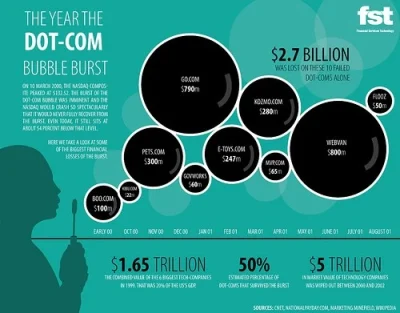
During the bubble, many investors proved themselves willing to overlook traditional performance metrics such as P/E ratio in favor of confidence in technological advances. Unfortunately, the dot.com boom was about as stable as a house of cards. The bubble began to pop in 2000, and the party was over pretty much by the end of 2001.
Some companies, like Pets.com, failed. I myself was laid off when my start-up went under (and Milani Marketing & PR was born.) When I was laid off in August, the job market looked grim. Then, September 11 happened. A nation was in trauma, and then there really were no tech jobs. I was lucky.
Other companies gave up much of their market capitalization. Cisco stock, for example, declined 86 percent, though the company remained stable and profitable. Some companies like Amazon, recovered to surpass their dot.com peaks. This online merchandising giant’s stock declined from $107 to a mere $7 but a decade later exceeded $200 per share.
GenXers All Grown Up
The years from 1998 to 2005 were turbulent indeed—and against that backdrop, the Gen Xers starting having families. Their kids will be the first generation that hasn’t known a world without the Web or wireless technology.
In 2003, MySpace was launched in California. Meanwhile, across the country work was underway on “The Facebook”, a social networking site targeted at Harvard students and viewed as the college version of Friendster. For a time, MySpace was the most visited social networking site in the world and in June 2006 surpassed even Google as the most-visited website in the United States. But in April 2008, Facebook overtook MySpace in the number of unique worldwide visitors and in May 2009 in the number of unique U.S. visitors. Game over, at least for then.

By 2005 marketers were mining individual demographics to create one-to-one marketing campaigns for cell phones and PDAs—and the advent of YouTube added mobile video capabilities. In 2006, Twitter was launched as a social networking and microblogging site, enabling users to send and receive 140-character “tweets.” Some of these micro-missives would get people fired. Others would inform us of political repression and unrest in countries around the globe. Regardless of message, Twitter would forever change how the average person views technology.
In 2008 a group of independent thinkers left what was then called MediaMap (now known as Cision) to build a media database the way they felt it should be built. They started with an editorial-calendar-only service which was hugely successful and then moved on to create a complete North American media directory and called it MyMediaInfo. MyMediaInfo went on to be acquired twice, first in February 2012 by Thompson Reuters, and then Nasdaq acquired Thompson Reuters in December 2012.
These were the early days of PRTech – the innovation has just begun!
Tune in next week (already September!) for Part 6 of our History of Marketing Series: 2010–2015: Marketing Goes Mobile.