
ICYMI…
Part 1: From Billboards to Bots: Marketing’s Wild Evolution
Part 2: The Dawn of Computing—the 1950s
The 1960’s (and 70’s): Women flex their marketing muscles
Where the 1950’s explored demographics, the 1960s saw marketers turn to “psychographics”—the study of how personality, values, attitudes, interests, and lifestyles come together to influence buying behavior. In doing so, agencies unleashed their creativity to produce more engaging, memorable, and influential ads. The Silicon Valley’s very own Stanford Research Institute led the way with its Values and Lifestyles program.
And in this environment of expansion and experimentation, women began to be considered for other than secretarial jobs. In the hit TV series “Mad Men,” copywriter Peggy Olson symbolizes the rise of feminism in marketing. Her character’s dedication to excellence in writing is still relevant to marketing almost 60 years later, given today’s emphasis on content marketing.

We haven’t even talked about great music, liberal idealism, and Flower Power (1967 was known in SF as “The Summer of Love”). If opening the door to greater opportunities for women wasn’t enough, the 1960’s also saw the introduction of the modern computer into business processes.
And it wasn’t long before marketers and manufacturers asked themselves the really big question: “Why would anyone want a computer at home?”
Believe it or not, the answer was: “to store recipes.” In the 1969 Neiman-Marcus Christmas catalog was featured the “must have” Kitchen Computer. For a mere $10,600, you got the computer, a cookbook, a super-nifty apron, and a two-week programming course.
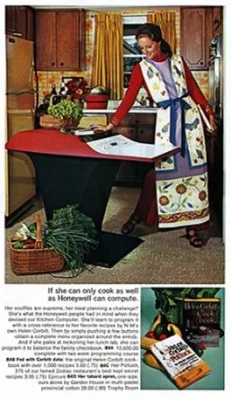
Not surprisingly, no kitchen computers were sold.
The 1970’s: The dawn of e-commerce
Though it may seem that e-commerce is relatively new, it was actually invented in the 70’s. The science of marketing had steadily become more serious. With the founding of customer targeting pioneer Claritas in 1971, companies could segment consumers into ever-smaller groups based on psychographics and census data. Long before privacy issues were top of mind, information from Claritas helped large retailers make a wide range of marketing decisions, such as where to locate stores.
In 1978, the baby boomers began to have children. This 71-million-strong “echo boom” generation experienced musical legends Aerosmith, Michael Jackson, Van Halen, Phil Collins, Alice Cooper, and so many other greats. These artists drove the Britney Spears-dominated youth market of the early 21st century.
Don’t miss our next installment Friday August 21 for our next in the Series, Part 4: 1980-Y2K: “Marketing’s Big Bang.”