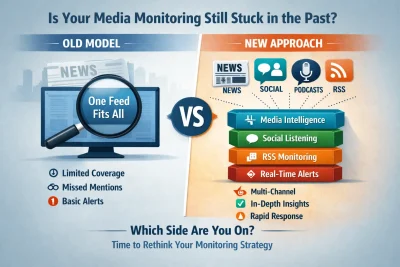
I’ve been reading a lot lately about how AI is affecting traditional media monitoring practices. Let’s start with what we know.
- AI is accelerating content production
- Media outlets are shrinking
- Audiences are fragmenting across platforms
Yet many PR teams are still relying on single-source media monitoring.
That’s increasingly a risk, especially as the C-Suite increasingly press the profession for metrics showing the ROI of their PR investment.
As Katie Paine recently noted in her reflections on the future of PR measurement, even seasoned experts may have underestimated how dramatically the media monitoring landscape would shift. The combination of AI-generated content, declining traditional newsrooms, and platform fragmentation is fundamentally altering how we approach media monitoring, PR measurement, and reputation management.
The real issue isn’t whether coverage exists. It’s whether we’re actually seeing it.
Why Single-Source Media Monitoring Is Failing
Historically, a single aggregator or alert tool could approximate brand visibility and who doesn’t love the free Google Alert. But, that model assumed:
- Centralized news distribution
- Stable publisher ecosystems
- Predictable amplification channels
That model no longer exists.
Today, brand mentions appear across:
- Trade publications
- Independent blogs
- Substack newsletters
- Podcasts
- Reddit threads
- LinkedIn commentary
- Regional and international outlets
- Review platforms
Widely acknowledged industry research supports this shift:
- The Institute for Public Relations (IPR) has repeatedly emphasized the increasing complexity of measuring digital communication ecosystems.
- The AMEC Global Communication Report highlights fragmentation and the growing challenge of comprehensive media measurement.
- Research published by enterprise monitoring providers such as Meltwater and Cision acknowledges that coverage increasingly spreads across social, forums, and non-traditional digital channels.
Unfortunately, basic alert tools and single-platform monitoring systems frequently miss meaningful coverage. And missed coverage means missed narrative insight.
What a Modern Media Monitoring Stack Looks Like
Reconsidering single-source media monitoring doesn’t mean abandoning efficiency. It means building a layered, intentional monitoring stack. And that will likely be customized to meet the unique needs of each agency and their client base. Fortunately, there are numerous options. Let’s look at what this might look like in practice:
Layer 1: Curated RSS Monitoring
What are we tracking? Track priority publications intentionally
Tools: RSS platforms like Inoreader
RSS monitoring will find:
- Trade publication articles
- Journalist blogs
- Niche industry sites
- Sector-specific newsletters
RSS monitoring replaces algorithmic discovery with curated source control. You decide what matters – again, this can be customized to meet the specialized needs of individual clients.
Layer 2: Enterprise Media Intelligence Platforms
What are we tracking?: Broad news monitoring and reporting
Monitoring Tools: Platforms such as Meltwater, Cision, Muck Rack
What they surface:
- National and regional news coverage
- Online publications
- Broadcast transcripts (where licensed)
- Basic sentiment scoring
- Share of voice reporting
These platforms provide reporting structure and executive dashboards for PR measurement. These are often key requirements at the enterprise level, but for smaller agencies there are more affordable options.
There are over 40+ tools in the media monitoring and measurement category of PRToolFinder.com making it easy to locate options to short-list whether you are driven by budget or function or both.
Layer 3: Social Listening & Narrative Analysis
What are we tracking? We’re trying to understand amplification and audience response
Tools: Talkwalker (Hootsuite) and other social media monitoring/listening platforms
What they will surface:
- Social media conversations
- Trend velocity
- Narrative clustering
- Forum discussions
- Influencer amplification
This is another category with around 30 different tools. Media coverage doesn’t end when an article publishes. Narrative momentum happens in social ecosystems as well.
Layer 4: Real-Time Alerts & Risk Monitoring
What are we tracking? Crisis detection and rapid response
Tools: Automated alerts layered across platforms
What it surfaces:
- Emerging reputation risks
- Rapid viral spikes
- Sentiment shifts
- Negative reviews or threads
I am not a crisis communication professional, buit I do know that speed matters more than volume in reputation management making the shortlist of platform and tool selection a lot easier if this is what you are prioritizing.
Monitoring Is Now Strategic Intelligence
- As if PR in general has not presented enough sea change, media monitoring is now no longer passive headline collection. Now it includes: Narrative tracking
- Amplification analysis
- Sentiment monitoring
- Risk detection
- Competitive benchmarking
The shift from aggregator to intelligence platform reflects a broader transformation in communications. Visibility is not defined by where news appears first. It makes measurement much more challenging in that now visibility can include:
- How widely your news spreads
- Who amplifies it
- How audiences respond
- How quickly your team acts
Being strategic about what and how you’re measuring results is crucial to preserving the priority of core message development and storytelling in PR. We have to figure this out fast.
Where PRToolFinder Fits into This Shift
The challenge isn’t a lack of media monitoring tools. It’s overwhelming choice (choice IS good).
There are now dozens of tools that deliver:
- Media Monitoring
- Social Listening
- RSS Platforms
- Some have dashboards, some do not
- Podcast Monitoring
- Reputation Management
- AI-Powered Narrative Analysis
Some have dashboards some do not. PRToolFinder was built to help PR professionals explore this fragmented tool landscape efficiently. You can:
- Compare enterprise media monitoring tools
- Evaluate RSS platforms for curated source tracking
- Identify social listening platforms for amplification analysis
- Explore measurement dashboards aligned with AMEC standards
- Discover emerging AI-driven monitoring solutions
It’s looking like in an AI-driven media environment, competitive advantage is going to include intentional media monitoring stack design — not convenience.
PRToolFinder helps you build that stack.