New PRTech in the PRToolFinder Ecosystem – (Before we dive in, I want to make sure you know that Reportable also has Media Intelligence offering, but in this post, we’re only covering the Reportable News Release.)
Reportable and the Changing Role of the Press Release — The press release is still alive. But what we expect it to do is changing.
You’re probably aware of this shift — I’ve spent a lot of years working with press releases and the services that distribute them, so I tend to think I’ve seen most of the variations on the theme.
Write the release. Choose your distribution. Send it out. Hope the right journalists see it. Measure the resulting coverage.
Simple enough—or at least it used to be.
Today, however, the person—or machine—discovering your company’s news may never see the release through a traditional media outlet at all. They may encounter it in search results, on social media, through a company’s website or newsroom, or as part of an answer generated by an AI platform.
That changes the question we’re asking of a press release.
It’s no longer just “How far can I distribute this?”
It’s also “How useful is this content once it’s out there, and how easily can people and machines understand it?”
That is what caught my attention about the latest version of Reportable, which I’ve recently added to the PRToolFinder database in the Newswires & Press Release Distribution Category.
Built for AI, Search and Reporters
Reportable’s Version 2.0 is specifically designed around this changing environment.
The company has structured the backend of its news release so that AI platforms and search engines can identify the important information contained in an announcement—including the central facts, organizations, people and topics. The release itself remains built around the things reporters have traditionally needed: a concise summary, key takeaways, quotes, images, video and downloadable resources.
I think that combination is important.
There’s a tendency when we talk about GEO (Generative Engine Optimization) to make it sound as though PR professionals now need to abandon everything we know about writing for people and start writing for machines; or make it sound like you need TWO press release versions.
I originally thought the two press release versions was the way to go, but maybe that’s not the right way to look at it any longer.
The more useful approach is to create content that is clear and useful to people, while also being structured in a way that machines can understand.
That’s essentially what Reportable is attempting to do with its new release format.
And it comes at a time when zero-click search is making it increasingly likely that someone will learn something about a company without ever clicking through to the original source. That makes the structure and authority of the source increasingly important.
The press release becomes a destination
The second thing I find interesting about Reportable is that it doesn’t treat the online news release as simply a digital version of a traditional wire copy.
The complete announcement lives on a dedicated, branded page where the organization controls the experience.
That page can include the announcement itself, key takeaways, quotes, executive information, images, videos, FAQs, downloadable materials and calls to action. It can also connect to Google Analytics, allowing organizations to incorporate release activity into their broader measurement.
This is particularly relevant to Reportable’s Lede & Link distribution model.
Reportable’s Lede & Link
Rather than distributing the entire release everywhere, Lede & Link distributes the essential elements of the announcement—the headline, opening information, key takeaways and featured image—and brings the audience back to the complete release on the organization’s Reportable page.
That is a different philosophy from the traditional “put the entire release on as many sites as possible” approach.
And I think it’s worth considering strategically.
When the full release is hosted somewhere you control, you can decide how the story is presented, what supporting information accompanies it and what happens after someone reads it. You can also see what audiences are doing on that page.
In other words, the release serves both as a news source and also a valuable ongoing content asset.
Two ways to tell the story
Reportable’s Version 2.0 also introduces a new visual template called The Splash, alongside The Standard template.
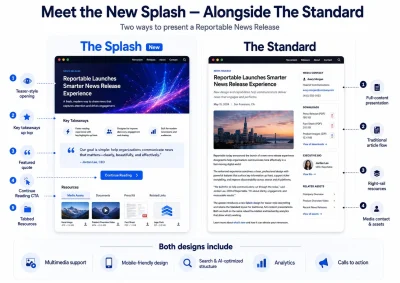
The Standard provides the more familiar news-release experience, while The Splash puts the key information, featured quote and visual elements more prominently toward the top of the page.
I like the fact that Reportable isn’t suggesting that every announcement needs to look like a microsite.
Different news calls for different treatment.
And there’s a practical reason for the information both templates prioritize. Reportable says that in its survey, 92% of respondents wanted a summary of the news and 66.7% considered access to downloadable images important.
That reinforces something we’ve known in PR for a long time: reporters want to get to the important information quickly, and they want usable assets when they’re going to cover a story.
The difference now is that those same characteristics can also contribute to creating content that works better as a searchable, shareable and machine-readable information source.
Distribution is only part of the equation
This is where I think the broader Reportable story gets interesting.
I’ve been watching the press release distribution category evolve for years, and it has become an increasingly complicated landscape.
We started with a number of traditional newswires. Then we had online distribution platforms. Some services focused on financial distribution. Some platforms were built around media databases and targeted outreach. There are multimedia release platforms. And now we’re adding AI discovery and GEO to the mix.
For someone trying to decide what they actually need, it can be difficult to compare these services because they aren’t always solving the same problem.
That’s something we’re planning to address more directly at PRToolFinder.
I’m working on a series of reports designed to help PR and communications professionals understand the press release distribution landscape—not just by listing vendors, but by looking at what the different models actually do, where they overlap, where they differ and what questions buyers should be asking before they choose one.
Because I don’t think the answer is necessarily “find the best newswire.”
It may be “find the approach that best matches what you are trying to accomplish.”
A more ecommerce-like experience?
There’s another aspect of my conversation with Reportable that I found intriguing.
The company talked about wanting to create a more standardized, ecommerce-like experience for users.
I think that is an interesting direction for PR technology in general.
We’re accustomed to having fairly structured buying experiences in almost every other part of our lives. We can compare options, see what is included, understand the process and make choices without having to decode an industry’s terminology first.
PR technology hasn’t always worked that way.
The press release category in particular can be confusing because seemingly similar services may offer very different things.
A more standardized experience could make it easier for communications professionals to understand not just what they’re buying, but what they’re actually trying to accomplish.
That’s something I think the PR technology industry could use more of.
So, is Reportable a newswire?
Technically, yes, distribution is part of what Reportable provides.
But I don’t think “newswire” fully explains what makes it interesting.
What caught my attention is the combination of structured content, AI and search optimization, an interactive multimedia release, a branded destination, Lede & Link distribution and analytics.
And, importantly, it doesn’t appear to be trying to solve the AI problem by forgetting about people.
It is trying to build one release that works for reporters, audiences, search engines and AI systems.
Whether this approach ultimately changes how organizations distribute every press release remains to be seen. GEO is still an evolving discipline, and nobody can guarantee that structuring a release will cause an AI platform to cite it.
But I do think the underlying question is one every communications professional should be thinking about:
What happens to our news after we hit “publish”?
Because increasingly, distribution is only the beginning.
Help me build the bigger picture
As I work on the upcoming PRToolFinder reports about press release distribution, I’d love to hear what you find confusing about this category.
What questions do you have about newswires, multimedia releases, AI discovery, GEO, search optimization—or choosing among all the different distribution options?
Send them my way. They may become part of the questions we tackle in the reports.
[Explore Reportable on the PRToolFinder platform and on the Reportable website→