Catch Me Up:
- Part 1: From Billboards to Bots: Marketing’s Wild Evolution
- Part 2: The Dawn of Computing—the 1950s
- Part 3: The 1960’s (and 70’s): Women flex their marketing muscles
- Part 4: 1980–Y2K: Marketing’s Big Bang
- Part 5: 2000-2010 – the Year the DOT-COM Bubble Burst
- Part 6: 2010–2015: Marketing Goes Mobile
- Part 7: The Algorithm Takes the Wheel
Final Installment of The History of Marketing (Short-Version)
The 2020s began with marketers facing a paradox.
They had more technology than ever.
They also had less certainty about what they could do with it.
The Privacy Wall Gets Higher
Privacy regulations continued to expand. Consumers became more aware of tracking. And the platforms themselves began changing the rules.
In 2021, Apple’s App Tracking Transparency framework required apps to obtain users’ permission to track them across apps and websites owned by other companies. For marketers who had grown accustomed to increasingly precise digital targeting, it was another reminder that the era of unlimited access to consumer data was ending.
The industry began talking about first-party data, privacy-first marketing, contextual targeting and the eventual demise of the third-party cookie; Google and advertisers are having a hard time “letting go.”
But while marketers were worrying about how to find people, they were about to discover something even more consequential:
What if technology could help create the marketing itself?
When AI Became a Marketing Tool
Artificial intelligence had already been part of marketing technology for years.
But in November 2022, OpenAI released ChatGPT, and suddenly millions of people could interact with generative AI through a remarkably simple interface: type a question, give it an instruction, and get an answer. This was big, very big. The implications for marketing and public relations were immediate.
AI could brainstorm headlines.
Write first drafts.
Summarize research.
Generate social posts.
Analyze data.
Create images.
Produce video.
Transcribe interviews.
Repurpose content.
Build presentations.
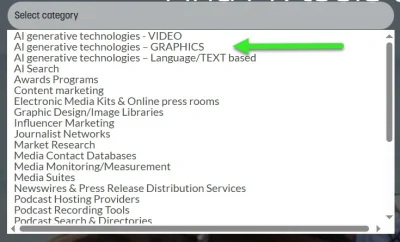
With increasingly sophisticated LLMs, most PR tools are incorporating AI into their existing platforms; and AI Agents perform tasks that once required multiple software programs, and several people.
PRToolFinder presently has 3 separate categories that are AI Native: AI Text, AI Video and AI Graphics. You’ll find the dropdown menu featured above on the database tab of the website.
From Managing Information to Creating It
Marketing technology had crossed an important line.
For decades, computers had primarily helped marketers manage information.
Now they could help marketers create it.
The difference is enormous.
Generative AI also changed the nature of the marketing technology landscape itself.
Instead of buying a tool designed to perform one specific function, marketing & PR professionals can increasingly interact with technology conversationally and ask it to perform a series of related tasks.
And then search changed.
From “How Do I Rank?” to “How Do I Become the Answer?”
For decades, marketers had learned to think about keywords, rankings, search engine optimization and the coveted first page of Google. I don’t know about you but I always avoided SEO like the plague as I found it to be so confusing.
But now avoiding the role of SEO in GEO can’t be ignored. As AI-powered search experiences emerged, the question began changing from:
“How do I rank?”
to:
“How does my organization become part of the answer?”
Google introduced AI Overviews in Search in 2024, giving users AI-generated summaries alongside traditional search results and changing yet again how people discover information online.
The Funnel Turns into Spaghetti
Meanwhile, social media continued to evolve at an almost absurd pace.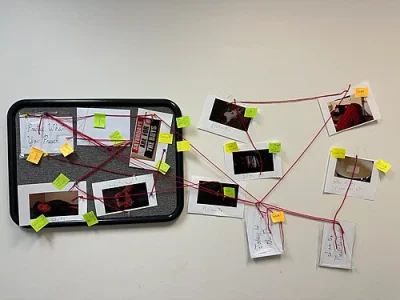
TikTok helped normalize short-form, algorithmically selected video. Instagram and YouTube followed the trend. Threads appeared in 2023 as another major platform for text-based public conversation.
The distinction between “social media,” “content marketing,” “advertising,” “commerce” and “customer service” is becoming increasingly difficult to maintain.
A person could discover a product in a TikTok video, watch a creator demonstrate it, ask questions in the comments, click through to buy it, post a review and then become an influencer for someone else.
The marketing funnel had become less like a funnel and more like a plate of spaghetti or a murder board out of a police detective TV Series episode.
From AI Tools to AI Teammates
And now, in 2026, we are watching another shift take place.
AI is moving beyond generating individual pieces of content toward becoming something closer to a marketing collaborator—or, in more and more cases, an agent capable of carrying out multi-step tasks.
The technology can research, draft, analyze, personalize, optimize and increasingly interact with other tools; with an interesting twist.
The More Powerful the Machines, the More Human the Skills
After decades of marketing and PR becoming increasingly automated and data-driven, the most valuable human skills may be becoming more important, not less.
Strategy.
Judgment.
Creativity.
Curiosity.
Empathy.
Taste.
Knowing what not to say.
Knowing when the data is wrong.
Knowing when the technically perfect message is completely tone-deaf.
And knowing the difference between something that is merely possible and something that is actually worth doing.
And That Brings Us Full Circle
Which brings us right back to where we started.
Marketing has always been a blend of art and science.
The science has simply become much more powerful.
And the art is still ours.
Conclusion
So, What Is the “New Normal”?
It’s a brave new world of marketing and communications.
There probably isn’t such a thing as a “new normal.”
There is only the next innovation.
We’ve gone from newspapers and radio to television, from television to computers, from computers to the Web, from the Web to social media, from social media to mobile, from mobile to algorithms, and from algorithms to artificial intelligence.
Along the way, we’ve accumulated an astonishing collection of tools for finding people, understanding people, reaching people, persuading people and, now, creating things for people.
Everyone became a publisher.
Then everyone became a journalist, or at least thought they were.
Then everyone became a creator.
And now everyone has access to a machine that can help them write, design, analyze, produce and distribute content at a speed that would have seemed like science fiction not long ago.
Information no longer travels simply top down or inside out. We have a 24-hour news cycle, personalized feeds, recommendation engines, creators, communities, algorithms and AI-generated answers.
The four Ps of marketing—price, product, promotion and place—haven’t exactly disappeared.
They’ve collided with technology.
Marketing, advertising and public relations have transformed themselves into something that would be almost unrecognizable to a marketer from 1939—or even 2013.
 And the pace of change isn’t slowing down.
If anything, it’s accelerating.
So where will we land?
I have absolutely no idea.
And after looking at the history of marketing, I’m pretty sure that’s the correct answer.
But I do know this: It’s never been more important to slow down and really listen to each other, learn from each other and create together.
AI can give us speed.
Data can give us insight.
Algorithms can give us reach.
Technology can give us capabilities our predecessors couldn’t have imagined.
However, none of them can replace human curiosity, judgment, creativity or connection.
If the past 90 years have taught us anything, it’s that the tools will keep changing. The people we’re trying to reach will keep changing. The technology will keep changing.
But the need to understand one another?
That probably isn’t going anywhere.
Collaboration and mutual learning enable us to achieve balance and ensure that we don’t ever lose the “art” of marketing by putting too much emphasis on “the science.”
Thank You for Reading!
Acknowledgement/Resources:
http://www.computerhistory.org/
www.allaboutmarketresearch.com/articles/art003.htm
http://www.uncp.edu/home/acurtis/NewMedia/SocialMedia/SocialMediaHistory.html
http://thenextweb.com/insider/2011/08/06/20-years-ago-today-the-world-wide-web-opened-to-the-public/
BMA National 90th Anniversary Book
THE END (OR JUST ANOTHER BEGINNING!)